

saladefriday: the collective bringing lebanese music and culture to the paris scene
Saladefriday has discreetly become one of the most avant-garde concert organisers in Paris, curating a mix of experimental, poetic and exhilarating music.
Saladefriday by adele monty
No concessions.
Saladefriday offers challenging, ambitious and demanding line-ups, with a mission to promote Lebanese music across Europe. A majority of events are hosted in Paris (where the founder and virtuoso drummer/percussionist Akram Hajj currently resides) and aim to blend the best of both scenes.
“Initially, I was looking for concerts that resembled what we had in Beirut, and I couldn't really find them in Paris. That motivated me to organize and perform concerts from our Beirut scene here in Paris, to try to blend the two scenes”. — Akram Hajj
I attended the last event to date, on February 17th. It started with an improv by Tracy Bedran (vocals), Akram Hajj (drums) and Paul Toubia (buzuk), and was followed by a set by Zeid Hamdan (guitar & vocals) and Uriel Barthélémi (drums), before ending with the duo Praed (Raed Yassin and Paed Conca).
As an avid concert-goer, it had been a while since I had reached the state of amazement and transcendence that many of us seek out in live music. Going to a Saladefriday event offered all of that, and more.
Profoundly political and poetical.
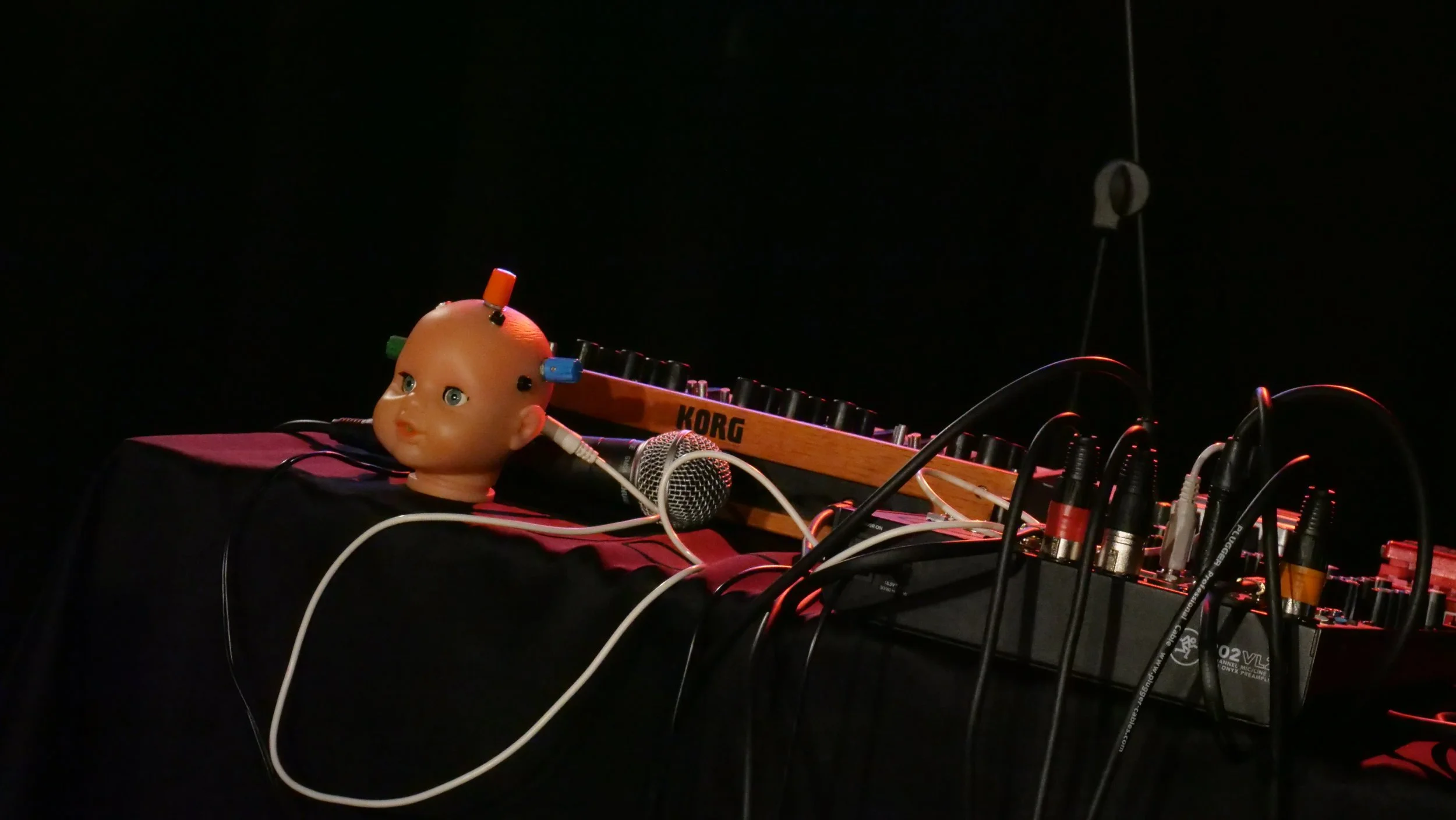
The first thing I saw while setting foot in The Wrong Side’s concert room, was a buzuk wired into a pedalboard, which certainly set the tone for a night of experimentation deeply engrained in traditional music.
The first set, improvised by the trio made up of Tracy, Akram and Paul put the audience in a trance-like state. Tracy’s ample singing, wired into a staccato effect controlled by Akram on the drums, was truly moving, while Paul’s buzuk created intricate melodies and riffs that complemented Akram’s precise and creative drumming. It was hard to fathom that it was the first time they were performing as a trio, as their set had the intensity and raw energy of a band that’s been improvising together for years. The second act was more festive, as the duo invited several guests on stage, including Uriel Barthélémi’s own young daughter and Zeid Hamdan’s friend and long-time collaborator T.I.E, whose vocal control and precise flow were a perfect match to Uriel Barhtélémi’s drumming. The final and crowning performance was Praed’s, with a chaotic set mixing clarinet and noisy electronic music, that had the public dancing well into the first hours of the morning.
Before the event, I was able to talk with Saladefriday’s founder, Akram Hajj, and here is what he told me about his organisation, motives and aesthetic choices.
ADELE: How did Saladefriday start? Can you tell me about the beginnings?
AKRAM: Saladefriday started when I was living in Beirut four years ago, in 2021, right after the Beirut explosion in 2020. One day, I didn't want to party anymore. We were partying three times a week and drinking a lot of alcohol. I had the idea to invite some friends over and to ask everyone to bring a vegetable or a piece of fruit, so that we'd improvise a salad with what the guests brought. We told our guests, "If you want to bring your instrument, we'll have a jam session or something like that." That was the idea originally: it wasn't even supposed to be concerts, just an occasion to have fun at home with some of my friends.
A few months later, I left Beirut to move to Paris, and it wasn't until 2024 that I started doing Saladefriday again, this time in my new home in the 18th arrondissement of Paris. I invited musicians, I invited friends. And the first evening was on a Friday, we had 60 people at my place, in my 35 square meter apartment. There wasn't enough room at all but we made it work. There were musicians who came after their concerts, with their double basses, their trombones, and jazz musicians with their synthesizers… It was all very DIY, you know?
I started thinking about doing it in public, and I thought about organising gigs. After a few weeks, I had friends who came from Beirut, who play in a band called SANAM. Sandy (Chamoun), the singer, and Anthony (Sahyoun), the guitarist. They were doing a concert with SANAM in Marseille, and they both had solo projects, and they came to stay at my place while traveling though Paris. That’s when I had the idea of organising a concert for them, with solo performances from each of us. That was Saladefriday’s first recipe: three solo concerts, and then we improvise together at the end. Just like a salad, you mix it up and improvise.
The first Saladefriday concert in front of an audience was at the 360 in the 18e arrondissement, in March 2024. We received about 100 people and it was amazing. It kind of took off from there. Gradually, friends and acquaintances started to hear about it, and I started to organise events with Saladefriday outside of Paris as well. I had artist residencies at the Villa Medici in Rome and European tours, so I decided to invite local Lebanese bands to play at our events. I've done this in Rome, Egypt, Switzerland, Berlin… And Beirut of course.
adele: When you book bands, how do you contact them? Are they usually people you know?
AKRAM: Before coming to Paris, I lived in Beirut for 10 years and played a lot of concerts there. I know the Beirut alternative scene pretty well, and they know me too. Often, Lebanese musicians contact me when they go on tour. For example, Praed is touring in Mexico and are spending a day in Paris before heading down to Lebanon. They contacted me to organize a concert for them, and I'm putting together a lineup with local musicians from Paris on the 17th of February.
A lot of musicians pass through Paris to go on tour, especially the Lebanese ones. There are a lot of direct flights from Lebanon that go through Paris, and France gives visas a bit more easily to Lebanese people than other countries. So, it works out well for us that most of them pass through Paris. I didn't do it on purpose, it was a complete coincidence but it works out well! When musicians pass through Paris before touring Europe or anywhere else, we're here to try and make their day in Paris unforgettable.
adele: Listening to the bands you've booked in recent years, I get the impression that there's a really huge experimental noise scene in Lebanon. Is that the case?
AKRAM: Yes, yes, we have a great noise scene in Lebanon, from 2010-2012 until now. It's probably because of everything we've experienced in Lebanon.
“I think we are bound to be more attracted to noise after going through a few wars, a few bombings, a political crisis, a huge economic crisis, a small revolution in 2019, the explosion in Beirut in 2020… When you live in a city that is so unstable, you tend to be more sensitive to noise, than jazz and blues [laughs].”
ADELE: You program a lot of improvisations; how do you organize them?
AKRAM: Usually, we all improvise together after concerts or after solo shows. And that's also a good occasion to start improvisations between local musicians and musicians coming from outside Paris. It's an opportunity to blend music from different cultures and backgrounds. It's more authentic when you improvise with people you don't know. For the audience too, they can see everything happening right in front of them.
AKRAM: What's your relationship with the Parisian scene? Do you feel close to other concert organizers, or venues?
I met Arnaud from Sport National a year ago; he organized a lot of concerts at Instants Chavirés. It was also at Instants Chavirés that I met a lot of people from the Parisian experimental scene. I found it was very different from what we have in Beirut. The type of music and even the type of experimental music in Paris is not the same as in Beirut. It made me curious to organize and promote concerts from the Lebanese scene, and to blend the two scenes together. There are things from each scene that complement each other. It’s two different schools.
“Initially, I was also looking for concerts that resembled what we had in Beirut, and I couldn't really find them in Paris. That motivated me to organize and perform concerts from our Beirut scene here in Paris, to try to blend the two scenes.”
ADELE: You're a musician yourself, would you like to tell me a little about your music?
AKRAM: My first project, which was quite well-known in Beirut, was a post-rock band called Kinematik, in which I played drums. We made three albums and toured in Europe together, and were active from 2015 to 2022. We’re currently taking a break, and now I play drums in a duo called Escalier 301B, and I have my own electro-acoustic solo project. Sometimes I play drums, sometimes percussion. I plug my percussions into my mixer with contact mics and use no-input pedals. I released my album, "My Life Is a Party I Can't Leave," on Bandcamp last year. It's my first solo album where I've played electro-acoustic drums. I play drums live with effects pedals—reverb, delay—that are usually used for guitar. It's pretty noisy.
Besides that, I compose music for performances, for dance shows and plays for instance. Recently, I played for the Centre Pompidou, in a “ciné-concert”. It was a different audience than the concerts I’m used to. I played music to accompany a 1924 black and white film called La Zone, which is about people who were forced to live on the outskirts of Paris because Paris was too expensive for them, and who came from all backgrounds and all political affiliations. It's very reminiscent of what Paris is currently doing with crack addicts.
ADELE: Does your association have a political dimension?
AKRAM: Yes, that was undoubtedly one of my motivations for creating this association. After October 7th, where so much European funding went to Israel, and voices speaking out for Palestine were being censored, it seemed even more important to have a self-funded collective and not be dependent on associations or government structures. To have as little to do as possible with the system. You can never completely escape the system… I'm not doing this in the woods! But the goal was to be independent of institutions and to do and say what we want. We've organised benefit concerts for Palestine and Lebanon during the war. We've also invited speakers to give talks, two or three times. There are many other associations that have done this as well, and there are many platforms that give space to pro-Palestinian musicians and artists who are against fascism and colonialism. It's also all these values that unite us.