Angine De Poitrine: A discussion with the infectious Quebec Band
Interview by Adele Monty and Gabriel Benabbou
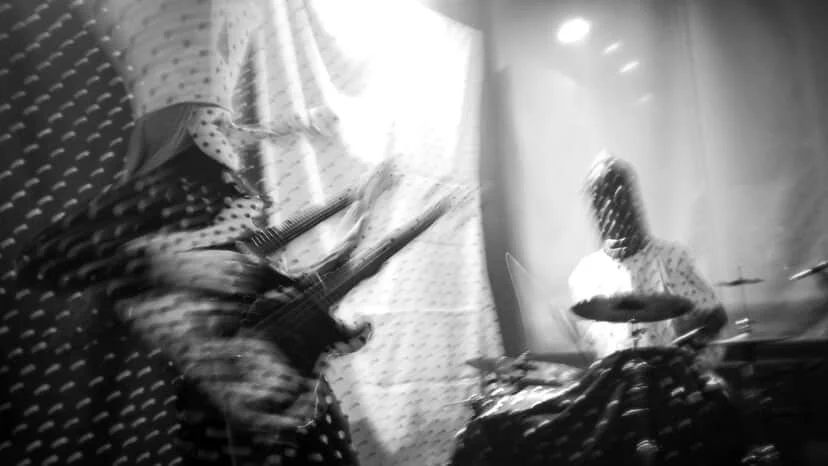
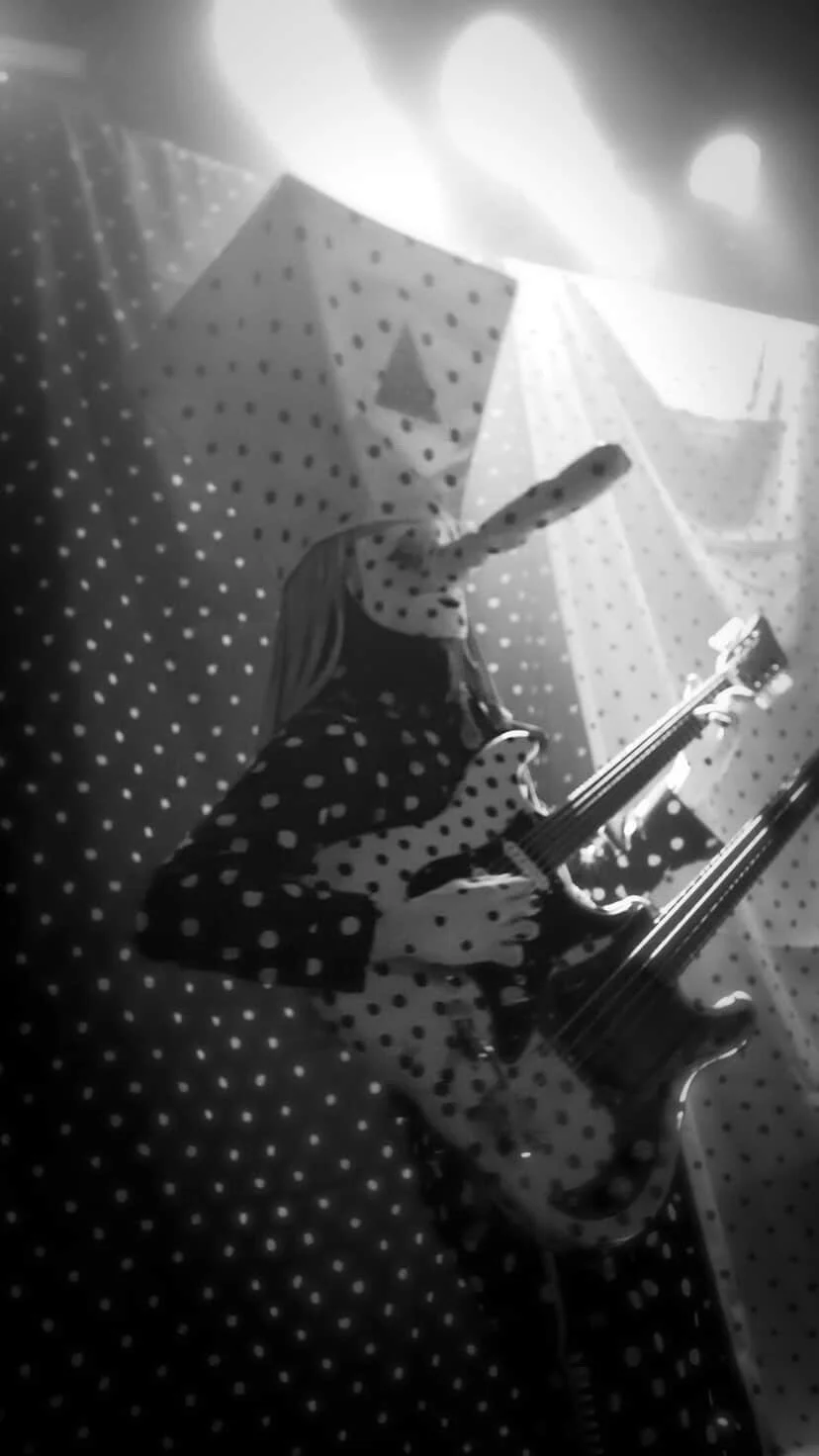
Angine De Poitrine at the Supersonic, Paris by Adele Monty
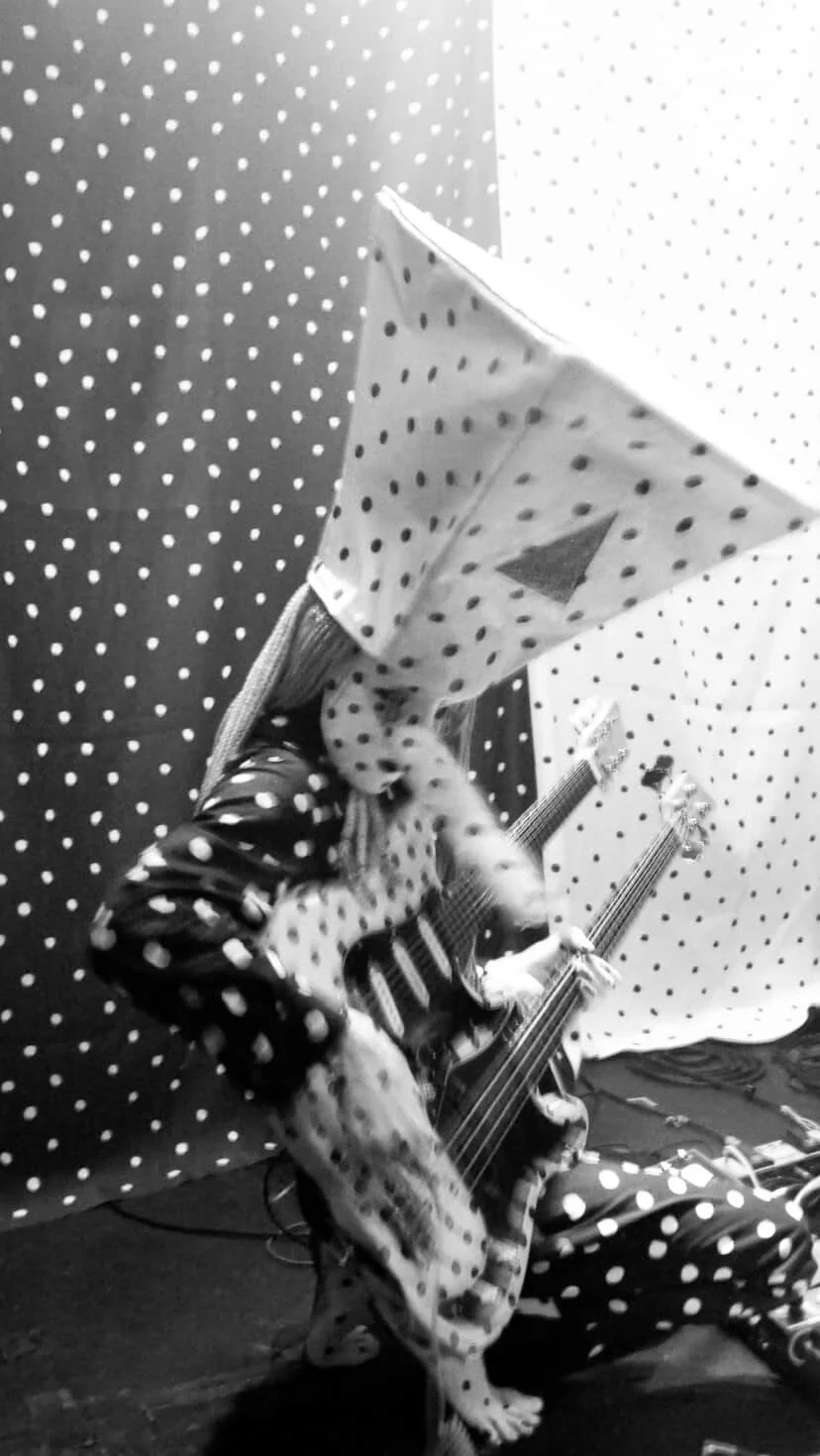
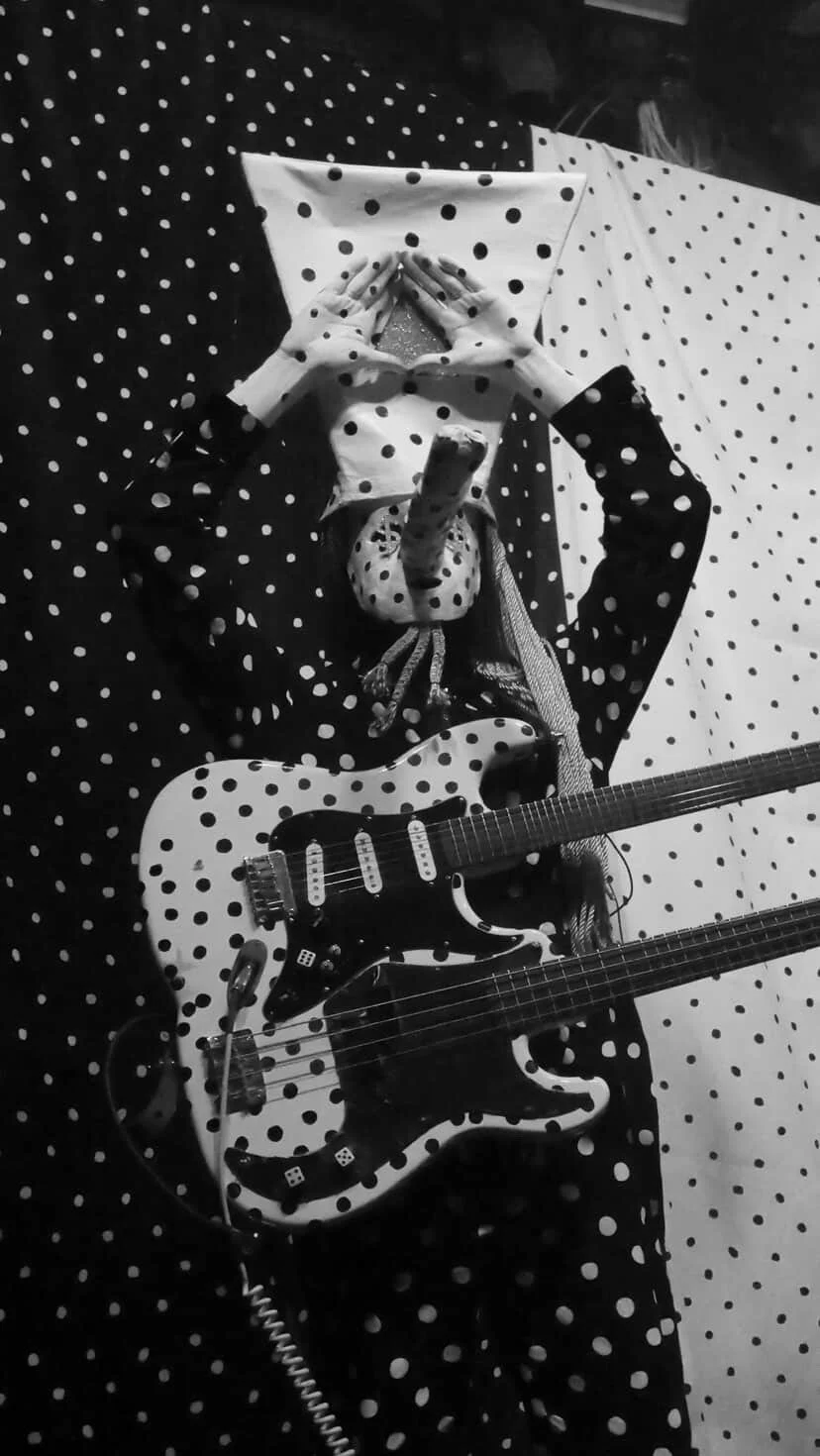
Quebec’s Angine de potirine is without any doubt one of the most exhilarating and weirdest bands to have surfaced this year, with a music that is both incredibly elaborate and delightfully funny and light-hearted. Visually, they are stunning. Two aliens, with papier-macher masks, and polka dotted to the toes (literally). Their most incredible feature, however, is not their looks, but their unique use of microtonal scales. Far from working a fad, they managed to explore the possibilities offered by this approach in a truly novel way, both completely experimental and dastardly catchy; And, boy, did they catch everyone’s attention. In the past few months, their rise to fame has been spectacular, from the Trances Musicales in December to their KEXP session a few weeks back. It’s a truly wonderful thing to see such a unique project given the attention it deserves, and we were truly excited to be able to interview Khn (guitar/bass) and Klek (drums), just moments before one of the most packed gigs the supersonic has ever hosted.
Adele: How would you describe your music? If you had to describe it in your own words.
Klek: We like to keep it broad, so we just say we play rock. Microtonal rock, to specify that it has this particular characteristic. It's easier.
Adele: I know you must get asked this a lot, but what are your major influences in creating your very atypical visual identity? Is there a reference to The Residents, for example?
Klek: No. We've never listened to them, which is the worst part. Actually, the costumes were initially a joke. We wanted to be able to play twice in the same place in the same week. When you’re in a band, you’re not supposed to play twice in the same week in the same place, otherwise people won't come. Initially, it was strictly to hide our faces and make our shows different. We also love a good joke; that's what we identify with the most. We like everything to be a bit light-hearted and fun. Over time, we've just learned to live with the idea that our band is particularly quirky. And now, it actually serves a purpose: it creates a separation between our private lives and our stage persona, and allows us to remain anonymous.
Adele: Your band’s been on an impressive rise these past few months. I've been following you since October-November, and I've seen your meteoric ascension, especially since your KEXP session. How does it feel? Had you been preparing for it for a while?
Klek: It wasn't really planned, no. There are a lot of areas in which we're a bit unprepared After the release of the KEXP session, there’s been a sudden spike, and that's quite an exceptional situation. But aside from the band's online life, everything else is pretty much the same as before: for now, we're still playing small gigs in small venues. But it's true that, in terms of booking, it's brought some great opportunities that haven't yet translated into our daily reality yet, But nothing’s a done deal.
Khn: There's still work to be done. We're incredibly charmed by the reception, but being people who maintain constant focus, we know that nothing is set in stone. Everything can be fleeting. To make sure it isn't, we have a lot of work ahead of us. Sometimes, it's still overwhelming.
Adele: I wanted to ask you about your musical influences. But I figured you've probably been asked that a thousand times, so I added some complications.
Klek: Only bands that start with the letter M?
Adele: We can do that too, if you like. [laughs]. I was wondering if you could give me three major influences: one you're proud of, a guilty pleasure, and one that's underrated, that nobody's ever heard of.
Klek: We'll take turns. It'll be fun to have both. My ultimate lifelong favourite is Gentle Giant, a prog rock band from the '70s. They were real weirdos, progressive music geeks. They opened for Black Sabbath, and the public booed them because it was so strange. The audience wasn't ready; they wanted heavy metal riffs, and Gentle Giants showed up with their violins, trumpets and medieval clothes (laughs). As for guilty pleasures, I'd say I have several. I think Dua Lipa really makes insane grooves. I'd say that's definitely a guilty pleasure. But I have more than one. We really listen to a wide variety of music. Calvin Harris's music in general, too, is full of really well-crafted bangers. As for underrated, I'm going to give a shout-out to my chums, from a band called Le Parc. They're a little younger than us, and they're absolute powerhouses. They play top-notch progressive rock. I hope they break through internationally, or at least, I hope they reach whatever fame they want to. Because seriously, they really deserve to blow up.
Khn: As for myself, I don’t really have any guilty pleasure : I don't like the way the question is phrased, because I don't feel guilty about listening to anything. I know that sometimes, you know, out of some kind of elitist feeling, you can feel guilty about secretly listening to hardcore pop. And you know, we all go through a phase where we try to identify with more elaborate, more complex stuff. I got out of that phase after college, studying music. Now, I listen to a lot of pop. Actually, you know, Calvin Harris is a name I had in mind, and all the big hits by Rihanna, Dua Lipa, and all the big pop stars who've had tracks produced by Calvin Harris. They're all killer bangers. I'm a huge Calvin Harris fan… and I don’t feel guilty about it. As for something that's underrated, I’d say maybe the Lounge Lizards. Because they're not famous, but they're recognised in the underground scene worldwide. They're a band with a really unique, truly atypical signature. They play music with a jazz aesthetic, but in a very pop rock format. Their energy is almost punk. When I discovered them, I was really blown away. Arthur Lindsay, the band's guitarist, has an approach to guitar that has absolutely nothing to do with jazz. He comes from the noise scene, and comes up with these kinds of riffs that don't make sense. It's like he's rejecting the notion of tone and notes. He never plays a clearly definable note or a melody. I love Arthur Lindsay's guitar playing! As for the artist I'm most proud of, it's a Quebec band called Deux Pouilles en Cavale, who really impressed me with their live use of the looper. They really inspired me to play in a duo. I followed them on tour, practically everywhere they played. I hitchhiked to see them.
Adele: What attracted you to microtonality?
Klek: As a drummer, I don't really have any concrete link to what I'm about to talk about, but I've always been a huge fan of "Oriental music," for lack of a better term: like Indian music, Japanese music, and so on. They seem to have an added complexity simply because of the added notes. The depth that quarter tones and third tones bring has always captivated me. Being people who really love tension and friction between the notes, it was almost natural for us to go in that direction. I built the first microtonal guitar we used myself. I added more frets on a guitar, with a saw. But since I'm not a guitarist, I wasn't using the instrument's full potential. So, I brought it to Khn. I told him, you have to try this, it makes absolutely no sense. Then, right away, the moment we started playing with it, we just laughed, you know, because of the friction created, and the proximity of the notes.
Khn: At first, you know, my idea was definitely to see how to get that kind of slightly Arabic-sounding colour. But I quickly moved towards a more modal approach, to try and exploit the potential for dissonance it offers, without falling into things that are very stereotypical and reminiscent of a culture that, ultimately, isn't mine. And, you know, my musical background, personally, is very much rooted in progressive rock, modern jazz, and contemporary music. It's just natural for me to use quarter tones in a language that's more cubist, let's say, more Zappa-esque in its phrasing. The way I use quarter tones allows me to explore chromatic approaches that are twice as long and then build more tension. But ultimately, most of the tunes we make could be harmonically compared to something along the lines of the tunes on John Scofield’s Überjam or Miles Davis's So What.
Gabriel: I feel like you've given away the recipe! Do you have a desire to bring a kind of freshness and come back with this completely new soundscape that isn't limited to King Lizard?
Khn: You're absolutely right. The goal is precisely to fully utilize the instrument. Even in Eastern music, it seems that microtones are often used as embellishments here and there. The idea for us is really to use them like any other note.
Gabriel: That's what really attracted me to your music. There are these notes that we're not used to hearing and that take their time to unfold. It's as if you've arrived with a new vocabulary, a concept that, for me, seems completely original. Your chords, riffs and gimmicks feel like they didn't come out of nowhere; we can see that you took the time to develop them before giving them to us. Can you explain the things that inspired you?
Khn: It's built day by day. I'd say that even between the album we have now and the one we're releasing in April, there's a big difference. There's been an evolution in our approach and aesthetic intent. In the beginning, I think we were leaning a bit more towards Turkish rock influences. And that's still the case, because we listen to a lot of Turkish rock and Middle Eastern music too. I used to listen to Japanese traditional music and gamelan records when I was a teenager. But I think we're going a bit deeper, into a more personal language that's very much rooted in a rock, groove aesthetic. It's an exploration, a door we've just opened, really. We haven't been playing with this for that long, when you think about it. In my 20 years of playing guitar, I've maybe spent four or five exploring microtonality.
Gabriel: Last question, do you plan to continue as a duo, sticking with this formula of a double-neck guitar, bass, and guitar? Are you happy with this approach?
Klek: For me, it's incredibly fulfilling. We've been playing music together for 20 years, and we've always played mostly as a duo. We've had three-piece bands, but never really more than that. After 20 years, playing together is more natural than talking even. I feel absolutely satisfied, especially with the reception we're getting. It’s a formula that works well for us: I don't expect to achieve anything more by changing things. But the future is always so uncertain. We're people who love change, and we haven't even released Volume 2 yet, and we're already working on demos for Volume 3. Anything can happen really.
Khn: What I find interesting about your question is that it makes me think about the role of the looper in all of this. Our musical concept is definitely based on it, to the point that becomes an instrument in itself. For me, it’s a demanding task in terms of mastering the tool, which I enjoy it. But it creates really significant limitations, not only in terms of arrangements, but also in the song’s structure. It's an interesting challenge to take on. What I find interesting is that it inevitably leads us into an aesthetic territory somewhat reminiscent of techno music. We listen to a lot of electronic music in general: I love listening to acid techno, and Klek listens to a lot of house. I think we wouldn't necessarily embrace this level of repetitiveness if we had the freedom to go anywhere, anytime. In another band we were in together, the song structures were radically different and much closer to Naked City's Speed Freaks than what we're doing now. I think it's good for us to have these boundaries and to acknowledge that we have these limits and to make it as dynamic as possible, but within the framework of repetition. I think that these limits are a good thing. If we got rid of it overnight, it would radically change our sound, and I don't think that's something we want to do.