

French Anti-Folk Rising Star Gabriel Kröger’s literary influences, DIY process, and more
By Adele Monty
Gabriel Kröger is a singer-songwriter who distinguished himself in the Parisian music scene through his raw performances and unique approach to folk-punk, sung in French. On stage, he wears a baklava to conceal his identity, which, far from creating a distance with the public, allows for a more direct confrontation and a rare strand of vulnerability.
We met up in early October 2025, right after he was selected in the first round of the “Inrocks Super Club”, a competition organised by the French journal, to discuss his relationship with the Parisian music scene and anti-folk.

GABRIEL kRÖGER BY aLESSANDRA bERRY
ADELE: You’ve just been selected for the semi-finals of the Inrocks Super Club, and for the occasion they published an article calling you “the anti-hero of anti-folk.” What do you think of that title?
gabriel: i really like it, they actually took it from my bio, where I proclaimed myself the anti-hero of anti-folk. I really like these two concepts and I think putting them together creates a nice kind of symmetry. On one hand,
the concept of “anti-hero” comes up a lot in my lyrics, which often have this element of saying “I’m not the brightest, not the most handsome, not the best singer, but screw that, I’m doing it anyway.”
As for anti-folk, it’s a music genre I feel Very close to, especially in the way I started writing music, with only a folk guitar, one percussion, and a mic. It’s a very DIY approach.
adele: I was quite surprised that you identify with that genre. When I listened to your album, it didn’t strike me as lo-fi, like a lot of anti-folk albums are. To what extent do you actually affiliate to the anti-folk?
GABRIEL: Generally speaking, I’d say I make rock music, not to overthink it.
The way I make music comes from a rock ethos. It’s above all a way to achieve a form of personal transcendence from a very authentic, very direct viewpoint.
I don’t want to conform to musical norms or conventional ways of doing things. Anti-folk (also called folk-punk) is more about the way Igot into making music. The album you listened to, Mémoires d’un Jeune Dégueulasse, is a complete reworking of my very first EP, Journal d’un Jeune Dégueulasse. They’re the same tracks, but rearranged with the musicians I play live with. That’s probably the reason why I’ve moved away from anti-folk a little. The songs in my album are a bit more produced than the originals on the EP, which are a lot rawer. The initial versions were a lot simpler: folk guitar, floor tom, and vocals. I recorded everything in a DIY manner, both because I didn’t know how to do it differently and because I didn’t have the money to pay for studio time.
Overall, the basis of my creative process has always been my acoustic guitar and me. I build the rest around that afterwards. It’s through that creation process that I identify with anti-folk.
ADELE: Can you tell me a bit more about your influences in a broader sense?
gabriel: They’re pretty wide-ranging. Generally, I listen to a lot of indie rock, but also some post-rock, from the early wave with bands like Slint, to the second wave with Mogwai, Godspeed You! Black Emperor, and even The Antlers. Of course, I also listen to a lot of anti-folk, like Crywank from England, or Car Seat Headrest. I also explore other music genres that are less similar to what I make, to look for specific sounds for certain instruments. I listen to metal (Gojira, Hypno5e) to find certain sonic textures or playing styles. And for certain electronic drum sounds, for example, I get my Inspiration from bands like The Strokes or Gorillaz.
When it comes to lyrics, I look to rap to find that efficiency and punchline quality. Obviously, that doesn’t inspire the rock aspect but it’s a huge influence on how to use words so they bounce off each other naturally, for instance.
ADELE: Your album and EP, Mémoires d’un Jeune Dégueulasse and Journal d’un Jeune Dégueulasse, are references to Bukowski. What are your literary influences when it comes to writing lyrics?
GABRIEL: I’ve always liked the idea of systems in art, when artists make references to other works. For example, Car Seat Headrest, a band I love, does that a lot: borrowing lyrics from Neil Young, or quoting a poet, or even referencing their own previous albums. I like when artists create intricate webs of references like that.
My EP and my album are called Mémoires d’un Jeune Dégueulasse and Journal d’un Jeune Dégueulasse, in reference to Bukowski’s Notes of a Dirty Old Man, which can either be translated as “mémoires” or “Journal” in French. Similarly, in Bukowski’s Notes of a Dirty Old Man, there are no uppercase letters, whether at the start of sentences or in chapter titles. The only uppercases are in the main title. That’s why I only kept them in the album title but not in the song titles, to carry on that reference. Obviously, I also found that some themes and the somewhat unflattering traits of the narrator in Bukowski’s work resonated with my songs’ persona, but I wouldn’t say that I follow the references to Bukowski directly, it’s more of a nod.
Similarly, my stage surname, “Kröger”, comes from a Thomas Mann novel called Tonio Kröger. Once again, it’s a nod to a book that had an impact on me. I like building these kinds of reference systems so that the listener can connect the dots and think, “Oh, that’s funny—he used that word here, or said that there—it’s a reference to this or that.”
adele: You emphasize the DIY (Do-It-Yourself) aspect of your work. Is that purely an aesthetic choice, or is it also a political claim?
GABRIEL: Nowadays, I feel like most musicians are forced to do everything themselves.
DIY has just become a broader reality. Compared to the 80s and 90s, when there was enough money in music that even emerging bands could record in studios with great equipment, today most of us have had to accept that we can’t access that.
Personally, I’ve always been very impressed by people who could do everything on their own. I was especially impressed by a musician friend who lived near me when I was younger. With my first band, he helped us record and mix our songs. I was still a teenager and it really amazed me. He was in his room alone and learned everything on his own: recording, mixing, editing videos, etc. That inspired me to learn to do everything myself, in order to have the same artistic freedom he had. I think there’s an inherent political dimension to making art—especially to making art without having a privileged access to it, whether that access be material, cultural, or social. I’m from the Seine-et-Marne region in the periphery of Paris, and it’s thanks to public and government-funded programs that I was able to make music. I’m very grateful for government-funded venues like SMACs (Scène de Musique Actuelles) and Youth centers like MJCs (Maison des Jeunes et de la Culture), which each year have less funding to support young people and emerging local artists. It’s so important that these still exist, because without them, so many young people would never have access to creative expression.
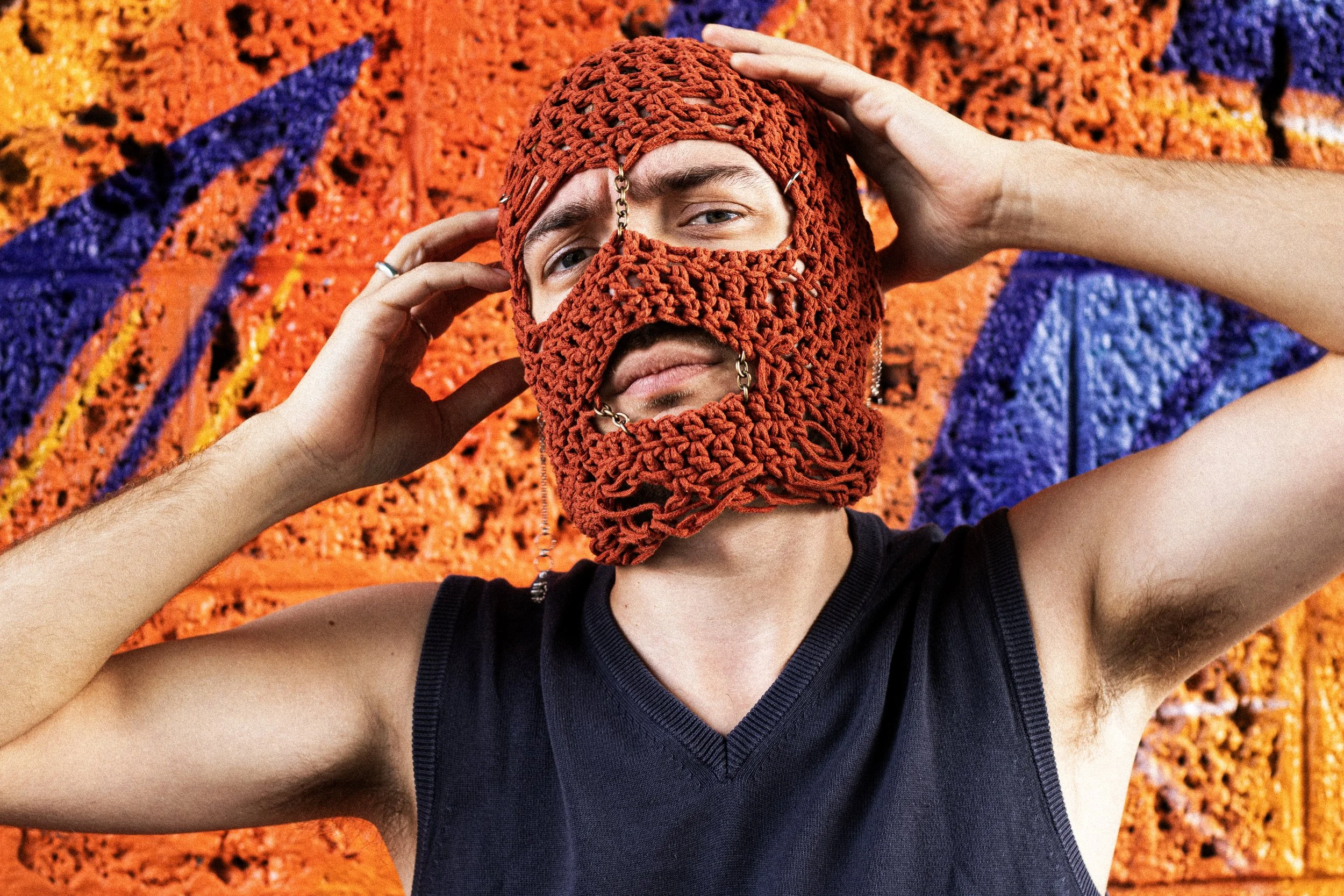
Gabriel Kroger by Alessandra Berry
adele: How do you reconcile singing in French with having so many anglophone references?
GABRIEL: It’s true that my instrumental influences are hardly French at all. Probably because the mainstream in France tends to be more restricted by the music industry—maybe out of fear of shocking French audiences. My compositional references mostly come from music genre that are mainly from anglophone countries: rock, indie, post-rock, folk. Writing in French has never been a struggle for me, however, it came naturally. I’ve always wanted to mix French song-writing that can be found in chanson française, rock, or rap and niche music genres.
adele: Do you think French audiences today are more interested in francophone music?
GABRIEL: Definitely. In recent years there’s been a real comeback. I remember the 2000s–2010s when everyone sang in English. I think the band Feu! Chatterton really shook things up around 2014. They managed to get famous, win awards from Télérama, or even play at the Olympia, with music that was in French, but still had rock and even experimental elements. Since then, I’ve seen more and more artists singing in French. Maybe it’s partly the fault of the industry dictating trends. The reluctance toward singing in French might come from higher up. There’s less money going into labels now, and I think that makes risk-taking harder, or constrained to some specific area of music. Rap, for instance, is a great example of how music has shifted over the past seven years or so into an era of niches. There are so many niche genres now—more experimental, but with audiences that connect deeply and passionately to them. For example, the artist Théa who blends rave techno and hyper-pop, two marginalised scenes, and in French. I think that’s an incredible example, it’s amazing and lots of people identify with it. It gives me hope.